W1-W3. Logic and Set Theory
1. Theory
1.1 What Is Mathematical Analysis?
Mathematical Analysis is the theoretical foundation that underlies calculus. While calculus teaches you how to use mathematical tools and techniques, analysis explains why these tools work. It provides rigorous justification for concepts that you may have learned in school mathematics, such as limits, derivatives, and integrals.
The key difference between calculus and analysis is the level of rigor. In calculus, you learn rules and procedures—such as the chain rule, L’Hôpital’s rule, or integration by parts—and apply them to solve problems. However, you might not fully understand why these rules are valid or when they might fail. Real analysis fills this gap by providing formal proofs and examining the underlying structure of real numbers and functions.
In real analysis, we address fundamental questions such as:
- What exactly is a real number? Is there a largest real number? After 0, what is the “next” real number?
- Why does the number
- If there are infinitely many real numbers and infinitely many rational numbers, why are there “more” real numbers than rational numbers?
- How do you take the limit of a sequence? Which sequences converge and which diverge?
- Can you add infinitely many numbers together and still obtain a finite result?
- What does it mean for a function to be continuous, differentiable, or integrable?
1.2 Why Study Mathematical Analysis?
Understanding analysis is essential for anyone who wishes to use mathematics rigorously. While you can apply calculus rules without knowing their justification, this approach can lead to errors when rules are applied blindly in situations where they don’t hold. Analysis teaches you the limits of applicability of mathematical rules and helps you avoid common pitfalls.
1.2.1 Example: Division by Zero
Consider the cancellation law for real numbers: if
For instance, the equation
Here’s a more subtle example. Let
If we cancel
which simplifies to
1.2.2 Example: Infinite Sequences
Let
Since
Therefore:
This implies either
But this is incorrect! When
The problem with the argument is that we assumed the limit
1.2.3 Example: Infinite Series
Consider the geometric series
Solving for
Now, apply the same technique to the series
This gives
The issue is that the algebraic manipulation is only valid for convergent series. The first series converges, so the manipulation works. The second series diverges, so the manipulation produces meaningless results.
Another problematic series is
These conflicting results show that the series does not converge, and we cannot manipulate it algebraically.
1.3 Logical Symbols
To study analysis rigorously, we use precise logical notation. Here are the most important symbols:
- Conjunction:
- Disjunction:
- Implication:
- Equivalence:
- Universal quantifier:
- Existential quantifier:
- Unique existence:
1.3.1 Mathematical Statements
A mathematical statement is a sentence that is either true or false, but not both. For example:
- “
- “Moscow is the capital of Russia” is a true statement.
- “Russia is the best!” is not a statement—it’s an opinion.
- “
Mathematical statements often have the form “If
Example 1: The implication
Example 2: The implication
1.4 Basic Set Theory
Modern analysis (referring to mathematics from the late 19th century onward) uses the language of sets. A set is a fundamental concept, though defining it rigorously leads to logical paradoxes. We adopt an intuitive approach: a set is a collection of objects called elements or members.
A set is defined solely by its members. Two sets are equal if and only if they contain the same elements. A set with no elements is called the empty set, denoted by
1.4.1 Set Notation
We typically work with sets of numbers. For example, the set
- We write
- We write
1.4.2 Subsets and Equality
Definition: A set
Definition: Two sets
Definition: A set
We often define sets using set-builder notation:
1.4.3 Set Operations
1. Union: The union of sets
2. Intersection: The intersection of sets
3. Difference: The difference
4. Symmetric Difference: The symmetric difference
5. Complement: If
Note that
6. Disjoint Sets: Two sets
1.4.4 Properties of Set Operations
Let
- Idempotence:
- Identity:
- Domination:
- Commutativity:
- Associativity:
- Distributivity:
- Absorption:
- Complement:
- Symmetry:
- Difference:
1.4.5 DeMorgan’s Laws
Theorem (DeMorgan’s Laws): Let
Proof of the first equality: We show that each side is a subset of the other.
First, suppose
Thus,
Conversely, suppose
Thus,
Since each side is a subset of the other, the sets are equal.
1.4.6 Cartesian Product
Definition: Let
For ordered pairs
- If
In general,
Example:
Note that these two sets are different.
1.5 Real Numbers
The real numbers, denoted
Geometrically, real numbers correspond to points on the real line.
Rather than defining real numbers from scratch, we use an axiomatic approach: we assume there exists a set
- Algebraic axioms (concerning addition and multiplication)
- Order axioms (concerning inequalities)
- Completeness axiom (ensuring there are no “gaps” in the real line)
1.5.1 Algebraic Axioms
The set
Addition Axioms: For all
- (A1) Commutativity:
- (A2) Associativity:
- (A3) Additive Identity: There exists an element
- (A4) Additive Inverse: For each
Multiplication Axioms: For all
- (A5) Commutativity:
- (A6) Associativity:
- (A7) Multiplicative Identity: There exists an element
- (A8) Multiplicative Inverse: For each
Distributive Axiom:
- (A9) Distributivity:
We define subtraction as
1.5.2 Order Axioms
There is a relation “
- (A10) Reflexivity:
- (A11) Antisymmetry: If
- (A12) Transitivity: If
- (A13) Totality: Either
- (A14) Addition Preservation: If
- (A15) Multiplication by Positives: If
We write
1.5.3 Completeness Axiom
The completeness axiom ensures that the real numbers have no “gaps”. There are several equivalent formulations. One intuitive version is:
(A16): Let
An equivalent formulation uses the concept of a least upper bound (discussed below):
(A16’): Every non-empty set of real numbers that is bounded above has a unique least upper bound.
1.5.4 Axioms of Equality
For all
- Reflexivity:
- Symmetry: If
- Transitivity: If
- Addition Property: If
- Multiplication Property: If
1.5.5 Properties of Real Numbers
From the axioms, we can derive many useful properties.
Theorem: Let
- Cancellation Law for Addition: If
- Cancellation Law for Multiplication: If
- If
- If
Proof of (1): Assume
By associativity (A2):
By (A3):
Proof of (3): By (A3) and (A9):
By (A4), there exists
Theorem: Let
- For any
- If
- If
- If
- If
- If
- If
- If
- If
- If
1.5.6 Absolute Value
Definition: The absolute value of a real number
The absolute value represents the distance from
Theorem: Let
- Triangle Inequality:
- Reverse Triangle Inequality:
Proof of (5): We have
Since
Proof of (7): Suppose
Conversely, suppose
1.5.7 Intervals
Definition (Bounded Intervals): For
- Closed interval:
- Open interval:
- Half-open intervals:
Definition (Unbounded Intervals): For
We define the extended real numbers
1.6 Important Subsets of Real Numbers
1.6.1 Natural Numbers
The natural numbers are:
Starting from the multiplicative identity
1.6.2 Integers
The integers are:
This is the union of the natural numbers, zero, and the negatives of natural numbers.
1.6.3 Rational Numbers
The rational numbers are all numbers that can be expressed as a fraction of two integers:
Every rational number can be written in canonical form (irreducible fraction)
Properties of Rational Numbers:
- Equality:
- Ordering: If both denominators are positive, then
- Addition:
- Multiplication:
- Additive Inverse:
- Multiplicative Inverse (for
- Division:
- Integer Power: For
1.6.4 Irrational Numbers
A real number is irrational if it is not rational. The set of irrational numbers can be denoted
Example:
Proof: Assume, for contradiction, that
where
Thus,
Thus,
Example:
Proof: Assume
Thus,
Thus,
Example:
Proof: Assume
Thus:
Since
Remark: The sum of two irrational numbers can be rational or irrational. For example:
1.7 Upper and Lower Bounds
Definition: Let
- An element
- An element
- The set
- The set
- A number
- A number
Convention:
- If
- If
- If
Examples:
- For
- For
- For
- For
1.8 Equivalence of Completeness Axioms
Theorem: The axioms (A16) and (A16’) are equivalent.
Proof: First, note that if a least upper bound exists, it is unique. Indeed, if
(A16)
(A16’)
1.9 Archimedean Property
Theorem: The set of natural numbers
Proof: Assume, for contradiction, that
In particular, if
By axiom (A14), adding
Thus,
Theorem (Archimedean Property): The following statements are equivalent:
- For any
- For any
- For any
Proof of (1): Assume there exists
Intuitive Meaning: No matter how large
1.10 Density of Rational Numbers
Theorem (Density of Rational Numbers): For any
Proof: Since
Let
- Since
- Also,
Thus,
Corollary: Between any two real numbers, there are infinitely many rational numbers.
1.11 Density of Irrational Numbers
Theorem (Density of Irrational Numbers): For any
Proof:
Case 1: If
Since
Thus:
So
Case 2: If
By Case 1, there exists an irrational number
Corollary: For any real number
This means that both rationals and irrationals are dense in
1.12 Countability
We have shown that there are infinitely many natural numbers, and thus infinitely many rational and irrational numbers. Both rationals and irrationals are dense in
To answer this, we introduce the concept of cardinality, a measure of how many elements a set contains.
Definition: Two sets are equivalent if there exists a one-to-one correspondence (bijection) between them. This means for each element in one set, there is exactly one corresponding element in the other set, and vice versa.
Definition: A set is countable (or countably infinite) if it is equivalent to the set of natural numbers
Definition: An infinite set that is not countable is called uncountable.
Theorem: A finite or countable union of countable sets is countable.
Proof: First, consider two countable sets:
We can list all elements of
For a countable union:
We list elements by grouping those with the same sum of indices (Cantor’s diagonal argument):
This establishes a bijection with
Theorem: The set of rational numbers
Proof: We can write
Each
1.13 Uncountability of Real Numbers
Decimal Representation: A real number
where each
Examples:
Theorem: The unit interval
Proof (Cantor’s Diagonalization): Assume, for contradiction, that
Write each
where
Then
Since
1.14 Cardinality of a Set
Definition: The cardinality (or size) of a set
For finite sets, cardinality is just the number of elements:
Examples:
1.15 The Principle of Mathematical Induction
When proving a mathematical statement, we use deductive reasoning: assuming axioms are true, we use logic to derive conclusions. We do not accept inductive reasoning (deriving general principles from specific observations), as this can lead to false conclusions.
1.15.1 Moser’s Circle Problem
Consider placing
Based on this pattern, one might conjecture that
This problem, noted by Leo Moser in 1949, demonstrates that inductive reasoning from patterns can fail.
1.15.2 The Principle of Mathematical Induction
Theorem (Principle of Mathematical Induction): For each
- Base step:
- Inductive step: For any
Then
Proof: Suppose the theorem is false. Then the assumptions (1) and (2) hold, but there exists some
Intuitive Explanation (Domino Effect): Imagine dominoes arranged in a line.
- If the first domino falls (base step),
- and each falling domino knocks over the next (inductive step),
- then all dominoes will fall.
1.15.3 Example 1
Claim: For all
Proof:
Base step (
Inductive step: Assume the formula holds for
We prove it for
Thus, the formula holds for
1.15.4 Example 2
Claim: For all
Proof:
Base step (
Inductive step: Assume the formula holds for
We prove it for
Thus, the formula holds for
1.15.5 Example 3
Claim:
Proof:
Base step (
Inductive step: Assume
(since
Thus,
1.15.6 Example 4
Claim:
Proof:
Base step (
Inductive step: Assume
Thus,
1.15.7 Example 5: Bernoulli’s Inequality
Claim: For all
Proof:
Base step (
Inductive step: Assume
(since
Thus,
1.15.8 Example 6
Claim: For all
Proof:
Base step (
Inductive step: Assume the inequality holds for
For
Now we need to show
This is always true. Thus, the inequality holds for
1.15.9 Remark on Limitations of Induction
Some statements cannot be proved directly by induction alone. Consider:
For
Thus:
However, a direct inductive approach fails: assuming
2. Definitions
- Mathematical Analysis: The theoretical foundation of calculus that rigorously explains why calculus works.
- Real Analysis: The rigorous study of real numbers, sequences, series, and functions.
- Statement: A sentence that is either true or false, but not both.
- Open Statement: A statement whose truth value depends on the value of a variable.
- Implication (
- Equivalence (
- Sufficient Condition: If
- Necessary Condition: If
- Universal Quantifier (
- Existential Quantifier (
- Unique Existence (
- Set: A collection of objects called elements or members.
- Empty Set (
- Element (
- Subset (
- Proper Subset (
- Union (
- Intersection (
- Difference (
- Symmetric Difference (
- Complement (
- Disjoint Sets: Two sets
- Cartesian Product (
- Ordered Pair (
- Real Numbers (
- Additive Identity (
- Additive Inverse (
- Multiplicative Identity (
- Multiplicative Inverse (
- Subtraction:
- Division:
- Absolute Value (
- Closed Interval (
- Open Interval (
- Half-Open Interval:
- Natural Numbers (
- Integers (
- Rational Numbers (
- Irrational Numbers (
- Canonical Form (of a fraction): An irreducible fraction
- Maximal Element (
- Minimal Element (
- Bounded Above: A set
- Bounded Below: A set
- Upper Bound: A number
- Lower Bound: A number
- Supremum (
- Infimum (
- Extended Real Numbers (
- Archimedean Property: For any
- Density (of a set): A set
- Equivalent Sets: Two sets are equivalent if there is a one-to-one correspondence (bijection) between them.
- One-to-One Correspondence (Bijection): A pairing where each element of one set corresponds to exactly one element of another set, and vice versa.
- Countable Set: A set that is equivalent to the natural numbers
- Uncountable Set: An infinite set that is not countable.
- Cardinality (
- Continuum: An uncountable set (often refers to the cardinality of
- Decimal Representation: Expressing a real number as
- Mathematical Induction: A proof technique for statements
- Base Step: Verifying that
- Inductive Step: Proving that if
- Inductive Hypothesis: The assumption that
3. Formulas
- Cancellation Law (Addition): If
- Cancellation Law (Multiplication): If
- Zero Product:
- Negation:
- Sign Rules:
- Inverse of Inverse:
- Fraction Multiplication:
- Fraction Addition:
- Fraction Division:
- Positive Product: If
- Negative Product: If
- Negative × Negative: If
- Inequality Multiplication (Positive): If
- Inequality Multiplication (Negative): If
- Reciprocal Inequality: If
- Absolute Value Definition:
- Non-negativity:
- Symmetry:
- Bounds:
- Multiplicativity:
- Triangle Inequality:
- Reverse Triangle Inequality:
- Absolute Value Inequalities:
- DeMorgan’s Laws:
- Set Distributivity:
- Archimedean Property (Form 1): For any
- Archimedean Property (Form 2): For any
- Archimedean Property (Form 3): For any
- Bernoulli’s Inequality: For
- Geometric Series Formula:
- Divisibility by 3:
- Product Inequality:
- Factorial Growth:
- Sum of Reciprocal Squares Bound:
4. Practice
4.1. Powers of Imaginary Unit (Lab 1, Task 1)
Show that:
Click to see the solution
(a)
- Recall the powers of
- Simplify the terms:
- Substitute and solve:
- The statement is true.
(b)
- Simplify the terms using the cycle:
- Substitute and solve:
- The statement is true.
4.2. Complex Number Arithmetic (Lab 1, Task 2)
Express the following in the form
Click to see the solution
(a)
- Expand the expression:
- Simplify:
- Answer:
- Answer:
(b)
- Use the conjugate property: For a complex number
- Apply to each term:
- Add the results:
- Answer:
- Answer:
(c)
- Multiply by the conjugate: Multiply the numerator and denominator by the conjugate of the denominator, which is
- Calculate the numerator:
- Calculate the denominator:
- Combine the results:
- Answer:
- Answer:
4.3. Find Unknown Real Numbers in a Complex Equation (Lab 1, Task 3)
Find the values of P and Q if
Click to see the solution
- Simplify the right-hand side: Multiply the numerator and denominator by the conjugate of the denominator, which is
- Calculate the numerator:
- Calculate the denominator:
- Combine and simplify:
- Equate the real and imaginary parts: We have
4.4. Convert Complex Numbers to Other Forms (Lab 1, Task 4)
Write the trigonometric and exponential forms of the following complex numbers:
Click to see the solution
(a)
- Find the modulus (r):
- Find the argument (
- Write the forms:
- Trigonometric:
- Exponential:
- Trigonometric:
(b)
- Find the modulus (r):
- Find the argument (
- Write the forms:
- Trigonometric:
- Exponential:
- Trigonometric:
4.5. Simplify Complex Numbers using De Moivre’s Theorem (Lab 1, Task 5)
Using De Moivre’s Theorem, simplify the following complex numbers:
Click to see the solution
First, convert the base complex number
- Modulus (r):
- Argument (
- So,
(a)
- Apply De Moivre’s Theorem:
- Simplify:
(b)
- Apply De Moivre’s Theorem:
- Simplify:
Answer:
4.6. Prove by Mathematical Induction (Lab 1, Task 6.1)
Using the principles of mathematical induction, show that for all positive integer values of n,
Click to see the solution
- Base Step (n=1):
- For
- Since
- For
- Inductive Step:
- Assumption (Inductive Hypothesis): Assume
- Goal: Prove that
- Proof:
- From the hypothesis, we can write
- Since
- Assumption (Inductive Hypothesis): Assume
- Conclusion: By the principle of mathematical induction, the statement is true for all positive integers
4.7. Prove by Mathematical Induction (Lab 1, Task 6.2)
Using the principles of mathematical induction, show that for all positive integer values of n,
Click to see the solution
- Base Step (n=1):
- For
- Since
- For
- Inductive Step:
- Assumption (Inductive Hypothesis): Assume
- Goal: Prove that
- Proof:
- The first term,
- Consider the second term,
- Therefore, the second term is
- Assumption (Inductive Hypothesis): Assume
- Conclusion: By the principle of mathematical induction, the statement is true for all positive integers
4.8. Prove by Mathematical Induction (Lab 1, Task 6.3)
Using the principles of mathematical induction, show that for all positive integer values of n,
Click to see the solution
- Base Step (n=1):
- For
- Since
- For
- Inductive Step:
- Assumption (Inductive Hypothesis): Assume
- Goal: Prove that
- Proof:
- From the hypothesis, we can write
- Since
- Assumption (Inductive Hypothesis): Assume
- Conclusion: By the principle of mathematical induction, the statement is true for all positive integers
4.9. Describe Sets in the Complex Plane (Lab 2, Task 1)
Determine the set described by the equation
Click to see the solution
- Interpret the Equation: The expression
- Identify the Center and Radius: In this equation,
- Geometric Shape: This is the definition of a circle in the complex plane.
- The center of the circle is the point
- The radius of the circle is 5.
- The center of the circle is the point
4.10. Complex Numbers in Trigonometric Form (Lab 2, Task 2)
Write the trigonometric form of the following complex numbers:
- Quadrant I:
- Quadrant II:
- Quadrant III:
- Quadrant IV:
Click to see the solution
- Quadrant I:
- Quadrant II:
- The reference angle is
- Quadrant III:
- The reference angle is
- Quadrant IV:
- The reference angle is
4.11. Find the Trigonometric Form of Complex Numbers (Lab 2, Task 3)
Find the trigonometric form of the following numbers:
Click to see the solution
- For
- For
- The reference angle is
- Since
Answer:
4.12. Find Square Roots of a Complex Number (Lab 2, Task 4)
Find the square roots of
Click to see the solution
- Solve for one variable: From the second equation,
- Substitute: Substitute this into the first equation.
- Solve for
- Multiply by
- Use the quadratic formula:
- Multiply by
- Find
- Find
- Since
- Since
- Write the Roots: The square roots are of the form
4.13. Compute High Powers of Complex Numbers (Lab 2, Task 5)
Compute
Click to see the solution
- Convert to Trigonometric/Exponential Form:
- Apply De Moivre’s Theorem:
- Calculate:
- Simplify: Since
4.14. Apply the Trigonometric Form of Complex Numbers (Lab 2, Task 6)
Compute:
Click to see the solution
- For
- Convert the base to trig form:
- Convert the base to trig form:
- For
- Convert the base to trig form:
- Since
- Convert the base to trig form:
4.15. Find Roots of Complex Numbers (Lab 2, Task 7)
Find the specified roots of the following complex numbers:
- The square roots of
- The cube roots of
- The fourth roots of
Click to see the solution
Use the formula
(a) Square roots of
- In trig form,
(b) Cube roots of
- In trig form,
(c) Fourth roots of
- In trig form,
4.16. Prove Newton’s Binomial Expansion by Induction (Lab 3, Task 1.1)
Prove the following statement by induction:
Click to see the solution
Let
- Base Step (n=0):
- LHS =
- RHS =
- Since LHS=RHS,
- LHS =
- Inductive Step:
- Assumption (Inductive Hypothesis): Assume
- Goal: Prove that
- Proof:
- Using Pascal’s Identity,
- Assumption (Inductive Hypothesis): Assume
4.17. Prove an Inequality by Induction (Lab 3, Task 1.2)
For any positive integer
Click to see the solution
- Base Step (n=1):
- LHS:
- RHS:
- The inequality
- LHS:
- Inductive Step:
- Assumption: Assume the inequality holds for some positive integer
- Goal: Prove it holds for
- Proof:
- Start with the RHS of the goal:
- By the inductive hypothesis, this is
- We now need to prove that
- This simplifies to proving
- Since
- Start with the RHS of the goal:
- Assumption: Assume the inequality holds for some positive integer
4.18. Determine the Domain of Functions (Lab 3, Task 2)
Determine the domains of the following functions:
Click to see the solution
- (a) Rational Function: The denominator cannot be zero.
- Domain:
- (b) Square Root Function: The expression under the square root must be non-negative, and the denominator cannot be zero.
- Analyze the signs of the factors. The expression is zero at
- The inequality holds for
- (c) Logarithm Function: The argument of the logarithm must be positive.
- This holds when
- Domain:
- (d) Piecewise Function: Analyze each piece separately.
- For
- For
- Combining the conditions for both pieces: The domain is
- For
Answer:
4.19. Determine the Range of Functions (Lab 3, Task 3)
Determine the range of the following functions:
Click to see the solution
- (a)
- The term
- Therefore, the denominator
- The function value is maximized when the denominator is minimized, which is at
- As
- Range:
- The term
- (b)
- The domain is
- The square root term
- Therefore, the function
- The minimum value is -1, which occurs at
- Range:
- The domain is
Answer:
4.20. Find Inverse Image of a Function (Lab 3, Task 4)
Let
Click to see the solution
- Find
- This means
- Adding 1 to all parts gives
- Find
- This means
Answer:
4.21. Find the Inverse of Functions (Lab 3, Task 5)
In each part, find
Click to see the solution
- (a)
- Let
- The inverse is
- Let
- (b)
- Answer: No inverse exists.
- (c)
- Let
- The inverse is
- Let
Answer:
- No inverse exists.
4.22. Sketch Transformations of a Graph (Lab 3, Task 6)
The graph of a function
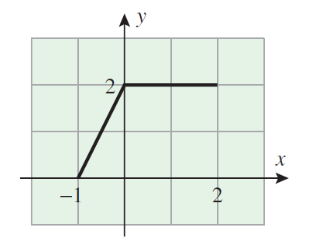
Click to see the solution
- (a)
- (b)
- (c)
- (d)
- A reflection across the y-axis (due to the negative sign).
- A horizontal stretch by a factor of 2 (due to the
- The point
4.23. Prove by Mathematical Induction (Chapter 1, Example 1)
By mathematical induction, prove that for all
Click to see the solution
Let
- Base Step: We test the formula for
- LHS =
- RHS =
- Since LHS = RHS,
- LHS =
- Inductive Step: Assume
- Assumption (Inductive Hypothesis):
- Goal: We need to prove that
- Proof: Start with the left side of the goal equation.
- LHS =
- Using the inductive hypothesis, substitute the sum in the parenthesis:
- LHS =
- This is equal to the right-hand side of the goal. Thus,
- Assumption (Inductive Hypothesis):
- Conclusion: By the principle of mathematical induction, the formula is true for all natural numbers
4.24. Prove the Irrationality of
Prove that the number
Click to see the solution
- Assume the opposite (Proof by Contradiction): Assume that
- Manipulate the equation: Square both sides of the equation.
- Deduce properties of
- Express
- Substitute and deduce properties of
- This shows that
- Find the Contradiction: We have concluded that both
- Conclusion: Since our initial assumption leads to a contradiction, the assumption must be false.
4.25. Prove by Mathematical Induction (Chapter 1, Example 3)
By mathematical induction, prove that for all
Click to see the solution
Let
- Base Step: We test the formula for
- LHS =
- RHS =
- Since LHS = RHS,
- LHS =
- Inductive Step: Assume
- Assumption (Inductive Hypothesis):
- Goal: Prove
- Proof:
- LHS of goal =
- Using the inductive hypothesis:
- LHS of goal =
- This is the RHS of the goal. Thus
- Assumption (Inductive Hypothesis):
- Conclusion: By the principle of mathematical induction, the formula is true for all
4.26. Prove the Irrationality of
Prove that the number
Click to see the solution
- Assume the opposite (Proof by Contradiction): Assume that
- Manipulate the equation: Square both sides.
- Deduce properties of
- Express
- Substitute and deduce properties of
- This equation shows that
- Find the Contradiction: We have shown that both
- Conclusion: The assumption that
4.27. Prove by Mathematical Induction (Chapter 1, Example 5)
By mathematical induction, prove that
Click to see the solution
Let
- Base Step: The statement is for
- For
- And
- Since
- For
- Inductive Step: Assume that
- Assumption (Inductive Hypothesis):
- Goal: We need to prove that
- Proof:
- Start with the left side of the goal:
- From our assumption, we know
- Now we need to show that this is greater than
- Dividing both sides by
- Since our assumption is for
- Therefore,
- Start with the left side of the goal:
- Assumption (Inductive Hypothesis):
- Conclusion: By the principle of mathematical induction, the inequality is true for all integers
4.28. Find Supremum and Infimum of Sets (Chapter 1, Example 6)
Find the minimum (min), infimum (inf), maximum (max), and supremum (sup) for the following sets, if they exist.
Click to see the solution
- For
- The smallest element is -1, so
- The infimum (greatest lower bound) is equal to the minimum, so
- The largest element is 2, so
- The supremum (least upper bound) is equal to the maximum, so
- The smallest element is -1, so
- For
- The smallest element is 0, so
- The set gets arbitrarily close to 1 but never reaches it. There is no largest element, so
- The least upper bound is 1, so
- The smallest element is 0, so
- For
- The largest element is 1, so
- The set gets arbitrarily close to 0 but never reaches it. There is no smallest element, so
- The greatest lower bound is 0, so
- The largest element is 1, so
- For
- The set is not bounded above, so it has no maximum or supremum.
- The set gets arbitrarily close to 1 but never reaches it. There is no smallest element, so
- The greatest lower bound is 1, so
4.29. Prove by Mathematical Induction (Chapter 1, Example 7)
By mathematical induction, prove that
Click to see the solution
Let
- Base Step: We must show that the statement is true for the initial value,
- For
- Since 3 is divisible by 3, the statement
- For
- Inductive Step: We assume that the statement
- Assumption (Inductive Hypothesis): Assume
- Goal: We need to prove that
- Proof:
- Substitute the expression for
- Since
- Assumption (Inductive Hypothesis): Assume
- Conclusion: Since both the base step and the inductive step have been proven, by the principle of mathematical induction, the statement is true for all integers
4.30. Prove the Bernoulli Inequality (Chapter 1, Example 8)
By mathematical induction, prove the Bernoulli inequality:
Click to see the solution
Let
- Base Step: For
- LHS =
- RHS =
- Since
- LHS =
- Inductive Step: Assume
- Assumption (Inductive Hypothesis):
- Goal: Prove
- Proof:
- Start with the LHS of the goal:
- Since
- Expand the right side:
- Since
- Therefore,
- Combining our inequalities, we have
- Start with the LHS of the goal:
- Assumption (Inductive Hypothesis):
- Conclusion: By the principle of mathematical induction, the inequality is true for all
4.31. Prove by Mathematical Induction (Chapter 1, Example 9)
By mathematical induction, prove the inequality:
Click to see the solution
Let
- Base Step: For
- LHS =
- RHS =
- The inequality is
- LHS =
- Inductive Step: Assume
- Assumption (Inductive Hypothesis):
- Goal: Prove
- Proof:
- Start with the LHS of the goal: LHS =
- Using the inductive hypothesis, we can write: LHS
- Now we just need to prove that
- Since both sides are positive, we can square them:
- Cross-multiply:
- This simplifies to
- Start with the LHS of the goal: LHS =
- Since all steps are valid, we have proven that
- Assumption (Inductive Hypothesis):
- Conclusion: By the principle of mathematical induction, the inequality holds for all
4.32. Prove the Irrationality of a Sum of Radicals (Chapter 1, Example 10)
Prove that the number
Click to see the solution
- Assume the opposite (Proof by Contradiction): Assume that
- Manipulate the Equation: Square both sides of the equation.
- Isolate the Radical: Rearrange the equation to solve for
- Find the Contradiction:
- From our initial assumption,
- However, the left-hand side,
- This leads to the statement that a rational number is equal to an irrational number, which is a contradiction.
- From our initial assumption,
- Conclusion: The initial assumption that
4.33. Prove the Triangle Inequality (Chapter 1, Example 11)
Prove the triangle inequality, which states that for any real numbers
Click to see the solution
- Use the property of absolute values: For any real number
- Therefore, we have
- We also have
- Therefore, we have
- Combine the inequalities:
- Adding the first pair of inequalities gives:
- Adding the second pair of inequalities gives:
- Adding the first pair of inequalities gives:
- Apply the equivalence from the previous problem: We have shown that both
- This is equivalent to the statement
- This is equivalent to the statement
4.34. Prove an Absolute Value Identity (Chapter 1, Example 12)
Prove that for any real numbers
Click to see the solution
- Prove the forward direction (
- Case 1:
- Case 2:
- In both cases, we have shown that if
- Case 1:
- Prove the backward direction (
- Case 1:
- Case 2:
- In both cases, we have shown that if
- Case 1:
4.35. Prove the Equivalence of Completeness Axioms (Chapter 1, Example 13)
Prove that the following two axioms of completeness for real numbers are equivalent:
- (A16) For any two nonempty sets M and N of real numbers such that
- (A16’) Every nonempty set of real numbers that is bounded above has a unique least upper bound (supremum).
Click to see the solution
- Prove (A16)
- Assume (A16) is true. Let
- Define a new set
- By the definition of the sets
- According to axiom (A16), there must exist a number
- The condition
- Therefore,
- Assume (A16) is true. Let
- Prove (A16’)
- Assume (A16’) is true. Let
- From this condition, any element of
- According to axiom (A16’), the set
- By definition of supremum,
- We also need to show
- Therefore,
- Assume (A16’) is true. Let
4.36. Prove that the Set of Natural Numbers is Unbounded (Chapter 1, Example 14)
Prove that the set of natural numbers
Click to see the solution
- Assume the opposite (Proof by Contradiction): Assume that
- Apply the Completeness Axiom: Since
- Use the Definition of Supremum: The number
- Consider the Successor: If
- Derive a New Upper Bound: If we subtract 1 from both sides of the inequality
- Find the Contradiction: The statement “
- Conclusion: The initial assumption that
4.37. Prove the Density of Rational Numbers (Chapter 1, Example 15)
Prove that for any two real numbers
Click to see the solution
- Use the Archimedean Property: Since
- Construct an Integer: Consider the number
- Construct a Rational Number: Divide the inequality by
- Show
- Show
- From step 1, we established that
- Combining these, we get
- From step 1, we established that
- Conclusion: We have shown that
4.38. Prove the Density of Irrational Numbers (Chapter 1, Example 16)
Prove that for any two real numbers
Click to see the solution
- Case 1: Assume
- Since
- Since
- Since
- Multiplying by the positive number
- Adding
- Since
- Case 2: General case (x, y may be irrational).
- By the density of rational numbers (proven previously), since
- Again, by the density of rational numbers, we can find another rational number
- Now we have two rational numbers
- Applying the result from Case 1 to the rational numbers
- By transitivity, we have
- By the density of rational numbers (proven previously), since
4.39. Prove Countability of Unions (Chapter 1, Example 17)
Prove that a finite or countable union of countable sets is a countable set.
Click to see the solution
- Case 1: Union of two countable sets.
- Let
- We can create a list of all elements in the union
- This process creates a single list (a sequence) that includes every element from both sets. To make it a formal enumeration, we can assign a new natural number to each element in the order it appears, skipping any element that has already been listed (if
- Since we can list all elements of
- Let
- Case 2: Countable union of countable sets.
- Let the sets be
- We can arrange all elements in a grid:
- We can list all these elements by traversing the grid diagonally (Cantor’s diagonal argument for pairing). We list elements with the same sum of indices:
- This method creates a single sequence that will eventually include every element from every set in the union. Therefore, the countable union of countable sets is countable.
- Let the sets be
4.40. Prove that the Set of Rational Numbers is Countable (Chapter 1, Example 18)
Prove that the set of rational numbers
Click to see the solution
- Represent
- Define Countable Sets: For each natural number
- Show Each Set is Countable: For any fixed
- Apply the Union Theorem: The set of all rational numbers
- Conclusion: We have expressed
4.41. Prove that the Unit Interval is Uncountable (Chapter 1, Example 19)
Prove that the set of real numbers in the closed interval
Click to see the solution
- Assume the opposite (Proof by Contradiction): Assume that the set
- Represent Numbers by Decimals: Let’s write the decimal expansion for each number in the list. (To ensure uniqueness, we avoid expansions ending in infinite 9s).
- … where each digit
- Construct a New Number (Cantor’s Diagonal Argument): We will now construct a new real number,
- We choose
- We choose
- Find the Contradiction:
- The number
- By its construction,
- This means our list, which supposedly contained all real numbers in
- The number
- Conclusion: The initial assumption that the set
4.42. State the Principle of Mathematical Induction (Chapter 1, Example 20)
State the Principle of Mathematical Induction and provide an outline of its proof.
Click to see the solution
- Statement of the Principle: Let
- (1) Base Step: The statement
- (2) Inductive Step: The implication “if
- Then, the statement
- (1) Base Step: The statement
- Proof Outline (by Contradiction):
- Assume the principle is false. This means that both conditions (1) and (2) are satisfied, yet there is at least one natural number
- Let
- By our assumption, the set
- By the well-ordering principle of natural numbers, every non-empty set of natural numbers has a least element. Let
- Since
- Since
- But now we can apply the inductive step (condition 2). Since
- This is a contradiction, because we defined
- Therefore, our initial assumption that the principle is false must be wrong.
- Assume the principle is false. This means that both conditions (1) and (2) are satisfied, yet there is at least one natural number